In this issue, you can read about:
- What lies behind the word 'empowerment' when talking about women and platforms in Kenya and South Africa
- Shining like a SweepStar: Estimated earnings of SweepSouth cleaners in South Africa between Minimum and Living wage
- Issues that courts worldwide have decided on for food delivery and ride-hailing workers
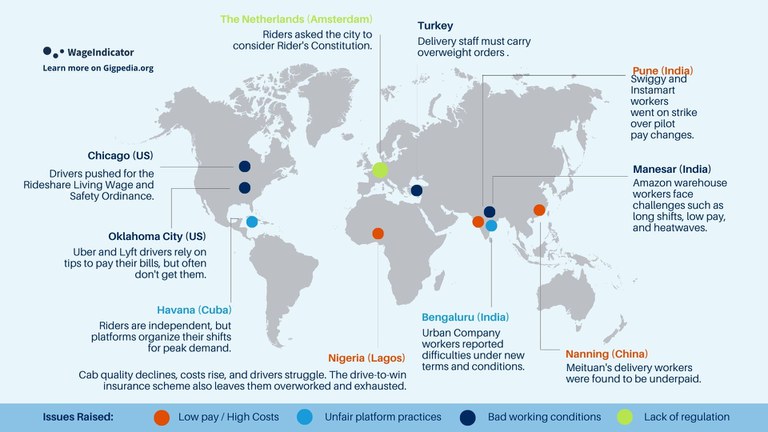
- Where workers have raised issues recently, from Cuba to China
And don't forget to take the Gig Quiz!
What’s behind the word ‘empowerment’? The case of female gig workers in Kenya and South Africa

"I feel empowered, but you have to have a thick skin".
Starting with the words of one of the women interviewed by Caribou Digital in Kenya for the research on The experience of women platform workers in Kenya, we wanted to explore the meaning of the word 'empowerment' when it comes to women and the gig economy, especially in emerging markets.
We hear a lot about so-called 'empowerment' when it comes to female gig workers. This is also the case in Africa, where platforms are growing exponentially in countries like South Africa and Kenya.
If it's true that platforms offer opportunities to earn money, what kind of individual resources does gig work require? What happens if strict social norms prevent access to platforms, and what projects have already proved successful in these contexts?
Find some 3 key facts below, or read the full blog here (5 min. read)
- It's not just about economic independence. Empowerment in the gig economy goes beyond mere economic independence. It encompasses the ability to exercise agency, make informed choices, and have control over one's life and work.
- Restrictive social norms and gender issues die hard. Strict gender roles in countries such as Kenya prioritise caregiving over paid employment for women. These societal pressures, coupled with older generations' perceptions that gig work is not legitimate employment, challenge women's autonomy and economic agency.
- Skills and resources are helpful, but so is pay. Access to training programmes, mentorship opportunities, and financial literacy education can significantly improve women's ability to navigate the digital marketplace. Unfortunately, women still struggle to receive fair payment for their services.
Shining Like a SweepStar in South Africa: SweepSouth Cleaners' Earnings Between Minimum Wage and Living Wage
|
Keywords: The ILO defines the minimum wage as the minimum amount of remuneration that an employer is legally required to pay to workers. The ILO also states that a living wage is the wage level necessary to afford a decent standard of living for workers and their families, taking into account the country's circumstances and calculated for work performed during normal working hours. |
In South Africa, when a cleaner joins SweepSouth, they become a SweepStar. Speaking of women and gigs in the country, 9 out of 10 SweepStars are female.
SweepSouth reports the median earnings of its workers in its annual Report on Pay and Working Conditions for Domestic Workers in South Africa. The most recent report was published in July 2023.
As a result, SweepStars can expect to earn an estimated monthly income that exceeds the mandatory national minimum wage. This data also reflects the latest Fairwork report for South Africa, where SweepSouth was awarded one point for fair pay, meaning that "the platform ensures that workers earn at least the local minimum wage after costs".
Unfortunately, the most common problem reported is that clients ask cleaners to work extra unpaid hours for work they have not booked. More than this, transport to clients' homes is not paid for, nor is the mobile phone data needed to use the app. These costs are reported to fall heavily on workers.
Unpaid work and high work-related costs remain a problem, even when one considers that the basic needs to be included in the WageIndicator calculations for a decent life (Living Wage) include not only food, housing, clothing, health, education, contributions and taxes, but also transport and telephone, which are necessary for SweepStars to work.
SweepSouth clearly states in its terms and conditions that it is only an intermediary that facilitates the connection between clients and cleaners. The cleaners do not have an employment relationship with the company, and it is up to the clients to increase their voluntary contributions and boost the cleaners' earnings.
Any questions about the Living Wage? We may have answered them here.
What have courts around the world been ruling on when ruling on gig workers?
Employment status (should we consider gig workers as employees or independent contractors?) is the dominant theme in the 123 food delivery and transport court cases WageIndicator has collected since 2017, across 22 countries and 63 platforms.
Key cases around the world include the long battle between Deliveroo Netherlands and the FNV trade union, which was recently decided in favour of the workers in 2023; a landmark ruling by the UK Supreme Court ordering Uber to classify its workers as employees with access to the minimum wage and paid holidays in 2021; and a series of decisions by various regional courts in Spain, the most recent of which came from the Barcelona Social Court, forcing Stuart Delivery to pay contributions for more than 100 delivery workers in February 2024.
Employment status has again been the most discussed topic so far this year, but you can browse through previous years by clicking on the image.
Step into the courts around the world with us and find out which platforms have been involved in court cases over employment status and in which countries the debate has been more lively.
What's more, find out what other important issues have been debated in the courts:
Want to look at court cases in more detail, with all the outcomes and parties involved? Check out the overall dashboard here.
Where Gig Workers Bring Up Issues Worldwide
More News from the Workers Worldwide
Hong Kong - In the debate about Uber's activities, some drivers have spoken out.
Kenya - The African Platform Workers Representatives were formed in Nairobi to “unite and amplify the voices of platform workers”.
Philippines - Grab and Move It signed an agreement with the police to improve rider safety.
South Africa - Bolt has blocked over 6,000 drivers over the last six months for misconduct. Drivers said it was "unjustifiable".
UAE - MoHRE (Ministry of Human Resources and Emiratisation) has the intention to create new air-conditioned areas for delivery workers across the country.
UK - In Glasgow (Scotland), residents are urging councils and police to act against "dangerous" delivery cyclists.
US - Boston officials denounced the reckless driving and dangerous behaviour of food delivery workers.
Did you know? Of the platforms assessed in the first Fairwork report for Spain, only two were found to comply with fair labour standards. La Pájara, the bicycle messenger cooperative, scored eight out of 10, but is no longer operational, and Just Eat, the food delivery platform, scored seven. Cabify, TaskRabbit, and Uber only met two of the established criteria and Glovo and MyPoppins remained at zero.
Gig Quiz Solution: a) Domestic work
"There are no shortcuts when it comes to labour rights, whether you are distributing food or caring for the elderly."
With these words, the Spanish Minister of Labour, Yolanda Díaz, has announced her ministry's intention to extend the Rider Law to domestic workers. Go Deeper (<1 min. read)