

Hogarù (Colombia): How to Make Cleaning Work Formal, Stable, and Motivating
Formality, stability, motivation. These are the three pillars on which Hogarù is built.
Hogarù is a Colombian platform for domestic services that employs cleaners (mainly women). It is committed to giving them the income and security they deserve, and to ensuring good working conditions in the long term.
More than that, it aims to provide workers with job satisfaction and room for development.
Platform expert Martijn Arets spoke to CEO Juan Sebastián Cadavid for the WageIndicator Foundation's Gig Work Podcast to learn more about this business model and its inspirations.
Here is a summary of their conversation. For the full version (in English) click here.
How it all started
Cadavid recounts how, in 2014, cleaners in Colombia were granted formal labour rights through the ILO, and the government began to take steps to formalise the relationship between cleaners and households. “With some 700,000 domestic cleaners, regulation was a politically sensible decision," says Cadavid.
Before that, Hogarù was "just" a platform that connected cleaners, handymen, and nannies. Since then, they have decided to become an employer, recruiting and training workers for this role.
The benefits of formalisation
"The fact that we offer formal work for formerly informal workers has a positive impact on the sector," says Cadavid. "In addition, it strengthens the bond between the workers. They talk to each other through Whatsapp groups. They are a community”.
Hogarú is also trying to make more cleaners aware of their rights, including those who are not employed by the platform but are interested in formal cleaning work. “Clients can also hire us to regulate their compliance with the law.”
The benefits of public-private cooperation
"The gap between the formal and informal markets has widened considerably in recent years. This makes it more attractive for private employers to hire informal cleaners”.
“The difference between formal and informal prices should not exceed 30 per cent. The government could solve this with a combination of regulation, supervision, and (dynamic) subsidy. Platforms can be valuable partners for the government in combating informal cycles.”
LISTEN TO THE COMPLETE INTERVIEW
GOOD NEWS FOR WORKERS - AND ALSO FOR GIG WORKERS!
WageIndicator has published Living Wage estimates for more than 165 countries.
A living wage is the income a worker should receive to live a decent life, based on daily expenses (food, transport, rent, utilities, etc.)
These estimates are available in national languages and currencies on the national WageIndicator websites for over 2,300 regions.
Why is this publication important for gig workers, too?
A Living Wage is also part of the Living Tariff, which is the amount a gig worker needs to earn per hour to have a sustainable income that covers living costs.
To calculate this tariff and negotiate fairer pay, gig workers can now use the Living Tariff tool developed by WageIndicator and GIZ to make informed decisions about their work and income.
FIND OUT MORE ABOUT THE LIVING TARIFF
And there is more to come!
We'll be holding a Living Wage information session every month.
Whether you're an individual, company, trade union, researcher, or policymaker, we'll answer all the questions you may have about Living Wages and our estimates.
The next meeting is scheduled for tomorrow, 17 May, at 1 pm CEST. Register here.
If time is tight and you can't make it, you can join the session on June 14, at 1 pm CEST. Register here.
The full calendar of Living Wage sessions is available here.
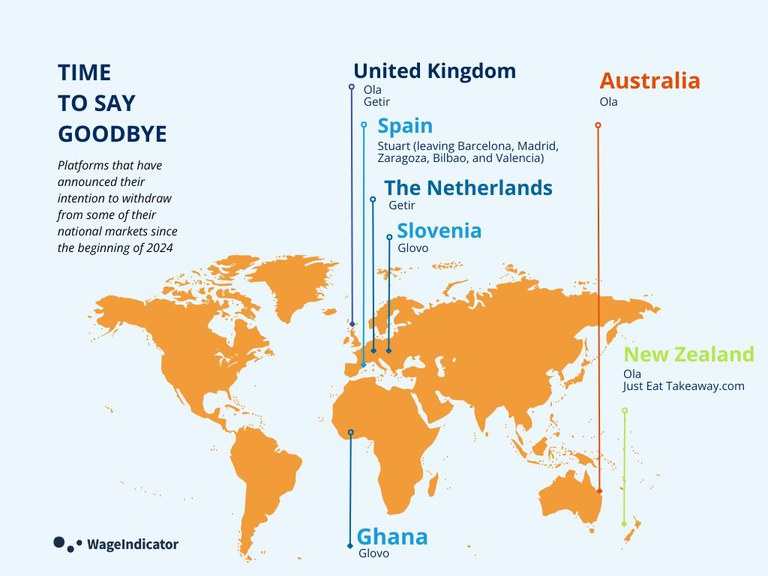
Time to Say Goodbye: Platforms Moving Out of National Markets
While Uber launched its service in Japan to address the shortage of taxi drivers, several other platforms have announced their decision to shut down in certain countries since the beginning of 2024.
Ola, one of Uber's biggest competitors, has shut down its operations in the UK, Australia, and New Zealand as the startup focuses on its home market of India and a project to invest in electrifying its fleet.
Just Eat Takeaway.com has also decided to discontinue all operations in New Zealand to "drive efficiencies and focus on building strong and sustainably profitable positions," while Stuart will cease deliveries in most cities in Spain because “the market is no longer strategic" due to inflation and restrictions imposed by the Rider Law.
Getir's withdrawal from the Netherlands, UK, and Germany is further evidence of the instability of the rapid grocery delivery sector amid high inflation, rising wages, and the need to cut costs.
Finally, Glovo riders have expressed grave concerns about their future following the company's announcement that it will leave Ghana. Taxes, inflation, and increases in the cost of doing business have all contributed.
At the beginning of May, Glovo also left Slovenia, and is now struggling at home: its owner, Delivery Hero, is wary of the possibility of further fines against the food delivery company in Spain.
Discover new and surprising visuals all the time
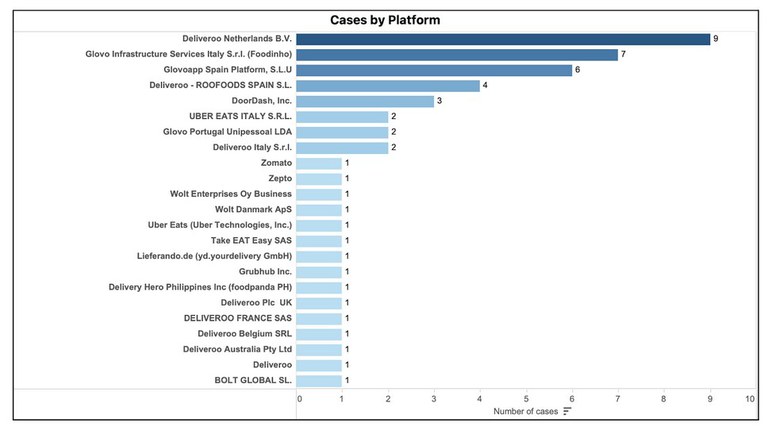
50 Court Cases in the Food Delivery Sector
The rapid expansion of the food delivery sector has brought with it legal complexities, particularly in relation to worker classification, labour rights, and regulatory compliance.
An analysis of Gigpedia's court case data shows a total of 50 lawsuits related to the food delivery sector between 2016 and 2024. These cases span different countries and platforms, reflecting the global nature of legal scrutiny in the gig economy.
See which platforms were more involved, where the cases took place, and what the courts decided.
You can get a full understanding of it at a glance:
Latest News from the Courts Worldwide
Portugal - The Portimão Labour Court has refused to recognise the employment contract between 27 couriers and Glovo.
UK - More than 10,000 drivers of London's iconic black cabs are suing Uber for £250m (€291.7m), claiming that Uber secured its licence to operate in London by illegal means.
US - The Wisconsin Supreme Court has ruled that Amazon Flex delivery drivers are employees. The decision is expected to result in Amazon Logistics facing a tax bill of more than 200,000 dollars.
Where Workers Strike and Why (April 2024 Edition)
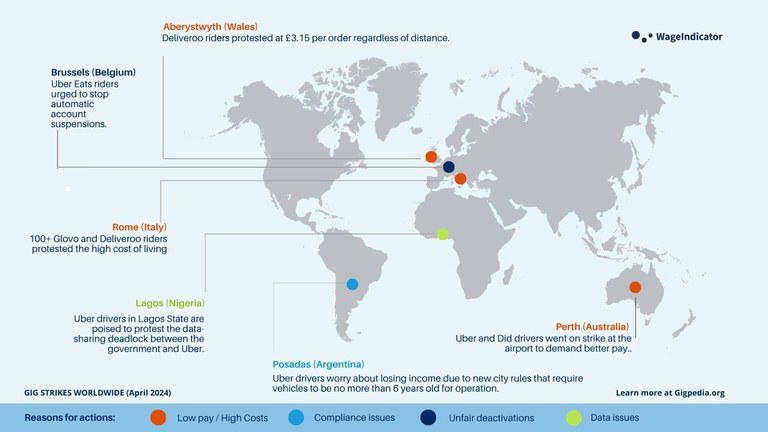
Sources: Misionescuatro.com, Thewest.com.au, Brusselstimes.com, Contropiano.org, Punchng.com, Cambrian-news.co.uk
More news from Workers WorldWide: Weekly Fees in Brazil, a New Union in Poland
Brazil - Rappi riders reported paying a weekly fee to use the app, effectively forcing them to start each week owing the platform.
Georgia - Platform workers are fighting for their rights with the support of the Georgian Trade Union Confederation. Conditions are getting worse for them.
India - Swiggy riders have denounced losing their health insurance coverage if they don't meet targets.
Poland - Związek Zawodowy Kurierów is a recently formed union representing people employed by digital platforms.
US - Starting in July, DoorDash will make monthly contributions equal to 4% of workers’ earnings for those who earn at least 1,000 dollars, excluding tips, in the second quarter.
Regulation News Bits: Glovo Under Control in Kenya and Spain, Portuguese Uber Offices Raided
Kenya - Glovo and Uber Eats have been ordered to open offices by the Competition Authority of Kenya for effective complaint resolution.
Portugal - Police and tax officials have raided Uber's premises in Lisbon as part of a wider investigation into some of its delivery partners.
Spain - The Public Prosecutor's Office of the Province of Barcelona has opened an investigation against Glovo for operating with false self-employed workers.
US - A New York City councilman has introduced a bill that would force delivery apps to offer tipping options before food is delivered, making it easier for customers to tip drivers.