

FAIRNESS IN FLUX
Can workers' rights coexist with a changing labour market?
(Spoiler: yes, but there is still work to be done!)
Dear reader,
Research has largely focused on how to create a fairer gig economy at a global level. However, the concept of fairness in the gig economy has to do with the changing nature of this labour market.
Significant benefits, such as flexibility and varied earning opportunities, go hand in hand with precariousness and the difficulty of finding enough gigs to make a decent living.
How can the needs and rights of gig workers be addressed in a context of relentless change?
We discussed this at the Oxford Internet Policy and Politics Hybrid Conference 2024.
"Fairness in flux" was the focus of the presentations WageIndicator gave together with the Central European Labour Studies Institute (CELSI) at the Oxford Internet Policy and Politics Hybrid Conference 2024.
It was a great opportunity to be part of an event that looked at the impact of the internet and technology on the labour market and how to more effectively regulate a rapidly evolving sector such as the gig economy.
Where the internet creates dilemmas, it also offers new opportunities for policy. How can these opportunities be seized without demonising the latest technological development?
Righting the wrongs
Existing or proposed regulations have a key role to play in righting the wrongs of the gig economy. Not to mention court cases, collective agreements, and self-regulation by platforms. Examples include the Crowdsourcing Code of Conduct, the World Economic Forum Charter of Principles for Good Platform Work, the Glovo Couriers Pledge, and the Labour Rights Index, which allows users to compare labour laws in 135 countries.
Iftikhar Ahmad, Head of the Centre for Labour Research and WageIndicator Global Labour Law Expert, painted a clear picture in his presentation "The current state of events in global regulations of the platform economy", stressing that many gaps in labour rights extend beyond the much-discussed social protection to other critical areas such as occupational health and safety.
Did you know? South American and Southeast Asian countries focus on social security, while in Europe and North America most legislation relates to the employment status of gig workers.
China, Chile, and South Africa are addressing the issue by creating a new category of employment for these workers.
Gig workers are like isolated islands
When it comes to regulatory innovation, the central role of collective bargaining agreements runs up against the harsh reality of the highly individualised nature of gig work.
Building a collective voice becomes a challenge when workers are geographically dispersed and don't share the same physical workplace.
Marta Kahancova, Managing Founder of the Central European Labour Studies Institute and Research Director at WageIndicator, in her presentation "Demand For (Flexible) Regulation - Does Collective Bargaining Have A Role In Platform Economies?", stressed that the majority of collective agreements currently in place for gig work are a "first step" in regulatory efforts rather than full-fledged traditional CBAs.
For now, at least, CBAs remain a useful but still evolving complementary tool to protect gig workers and open the door to future sectoral agreements.
Cool tools for better work
Then, it was time for Paulien Osse, co-founder of WageIndicator, Daniela Ceccon, data director of WageIndicator, and Nadia Pralitasari, manager of WageIndicator Indonesia, to present the Living Tariff tool, developed with GIZ to provide workers with easily accessible information to calculate fair remuneration for their work.
WageIndicator has extended its Living Wage / Living Income concept to self-employed, platform-based forms of work.
The result is a tool that includes the social security costs typically paid by employers and takes into account the variability of rates across platforms, regions, and types of work.
Case studies from Living Tariff pilot countries include Kenya, Pakistan, and Indonesia, as well as insights from the global context.
Did you know? The Living Tariff tool not only provides workers with salary and cost of living information, including how to calculate direct and indirect costs such as waiting times, cancellation fees, and non-payment by clients, but also information on relevant labour laws, holidays, standard working hours and more.
Let’s spread the word!
As explained in the closing discussion with the platform expert Martijn Arets, raising awareness of the availability of tools and information among target audiences remains the most challenging task.
This type of tool has the potential to contribute to collective bargaining by empowering individual workers through knowledge.
It's (also) up to the workers themselves, but everyone can help spread the word.
If you think it's worth it, get in touch and try out the Living Tariff tool on the Kenya, Indonesia, and Pakistan websites.
In the meantime, have a nice day!
The WageIndicator Gig team

Brazil - The 13th Labor Court of Fortaleza recognised the employment relationship between a rider and the company Ifood.
Canada - Uber Canada is making several changes to provide drivers in B.C. and Ontario with the estimated fare and expected destination before accepting a ride.
France - Uber appealed to overturn the Paris mayor's decision to uphold her decree banning VTCs from certain areas of the capital.
Italy - The Turin court ruled in favour of three trade unions that had asked Glovo for information on how the platform evaluates and selects delivery drivers.
Spain - Madrid's Social Court Number 42 has condemned Amazon for hiring 3,688 delivery workers as false self-employed workers between October 2019 and November 2021.
The Netherlands - The Dutch Data Protection Authority imposed a 10 million euros (10.8 million dollars) fine on Uber for lack of transparency in handling its drivers' personal data.
UK - An estimated 3,000 Deliveroo, Just Eat, and Uber Eats riders walked out across the country, with massive demonstrations taking place in London and Brighton. They protested against low fares.
WHAT’S NEW ON GIGPEDIA
Get a grip on the global gig economy with new visuals every month
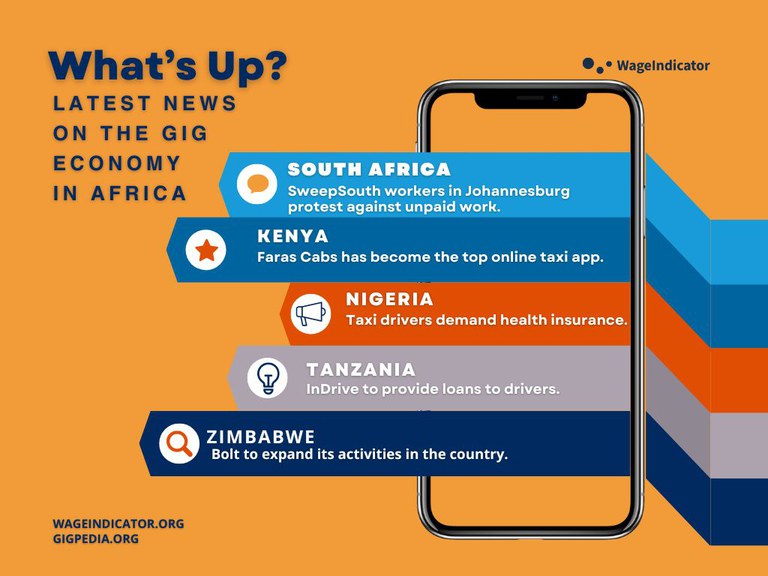
Sources: Restofworld.org, Businessdailyafrica; Techinafrica; Technext24; Techcabal

Spain
- The National Court has rejected an appeal by the General Treasury of Social Security, which wanted Glovo to pay 64 million euros in fines from the Labour Inspectorate. A few days later, the Spanish Data Protection Agency has fined the platform 550,000 euros for misusing the personal data of delivery drivers who use its platform.
- The Supreme Court has once again ruled in favour of Maxi Mobility, a subsidiary of Cabify, opening the door for the platform to add another 1,000 VTC licences in the Madrid region.
US - Members of the Minneapolis City Council will try again to push through a citywide ordinance that would bring ride-hailing drivers closer to the city's 15-dollar minimum wage. Mayor Frey vetoed a previous ordinance in August.

Did you know? Indian workers reported taking huge pay cuts after being laid off from companies such as Twitter, Amazon, and Microsoft in the US last year and returning home.
India
- The Telangana Gig and Platform Workers Union has filed a petition against two-wheeler ride-hailing companies, citing safety concerns for passengers.
- Urban Company workers held a protest in Hyderabad against the company's ‘discriminatory practices’.
Mexico - A group of 20 drivers from the Colectivo de Conductores de Plataforma de Nuevo León (CCOOPLA) held a demonstration in Monterrey to demand a fairer pay.
Spain - In Valladolid, the Workers' Commissions (CCOO) reported more than 100 cases of riders renting their accounts to migrant workers. The problem is not new, but it has become chronic.
Turkey - The Istanbul Couriers Federation (İstanbul Kuryeler Federasyonu Başkanları) gathered in front of the Istanbul Palace of Justice and called on the government to introduce harsher punishments for those who cause the death of couriers in road accidents.
US
During a press conference, the New York Attorney General's office said that Uber and Lyft drivers will receive a payout from a $328 million wage theft settlement by 1 March 2024.
The two companies were accused of withholding wages from workers in the form of sales taxes.

Czech Republic - With 30% growth in the last year and a fleet of 7,000 active couriers per month, Wolt is aiming to become number one in the Czech market.
Did you know? Rappers, singers, and ordinary gig workers are writing songs about delivery life that are going viral.
India
- Swiggy reportedly fired 400 employees, or nearly 7% of its workforce.
- Ola, the ride-hailing platform, has launched e-bike services in Delhi and Hyderabad.
- Flipkart is rolling out same-day delivery of products for its customers in over 20 cities from February.
US - Uber is putting 30 million dollars into the Uber Innovation PAC, a committee dedicated to supporting public policy initiatives. The company said it plans to “amplify thoughtful candidates and campaigns that are willing to take on the tough challenges that our state’s collective future faces.”
Did you know? Delivery Hero is exiting its stake in rival Deliveroo after acquiring it in mid-2021.
In mid-December, Delivery Hero also announced a 13 percent reduction in staff at its Berlin headquarters.