
Dear reader,
We're back to talking about employment status in relation to gig workers after the Biden administration announced it was revamping the 'gig worker rule'.
After the Labour Department unveiled the rule that makes it harder for companies to treat some workers as independent contractors, a group of freelance workers filed a lawsuit in the Georgia federal court, alleging that the rule is vague and violates the Constitution.
What is the relationship between the Biden rule and another rule approved by the Trump administration in 2021? Why is this considered a landmark, and what are the reasons for the workers' opposition?
What to know
In the United States, most federal and state labor laws, such as those entitling workers to minimum wage and overtime pay, prohibiting discrimination, or protecting the right to unionize, apply only to a company's employees.
A Trump-era rule from 2021 favoured by business groups stated that workers who had the ability to work for competing companies and benefit from “entrepreneurial opportunities” could be deemed as contractors.
In 2022, the Biden administration repealed the Trump-era rule and proposed a new rule saying that a worker should be classified as an employee under the law based on several factors, including the degree of control an employer has over a person's work and the permanence of the working relationship.
By revamping it at the beginning of January, the DOL stressed that it was seeing misclassification in sectors it hadn't seen before, and the misclassification of independent contractors also imposed huge costs on federal and state treasuries.
What they said
“This is absolutely what needs to happen in the jobs where basically an algorithm is our boss,” Nicole Moore, President of Rideshare Drivers United, said.
Acting Labour Secretary Julie Su told reporters the rule would help preserve essential worker rights and “create a level playing field for businesses.”
In a statement, Uber pointed out that the rule would not affect them because it is a technology platform, not a transport company. “This rule does not materially change the law under which we operate and will not impact the classification of the over one million Americans who turn to Uber to earn money flexibly.”
Lyft made it clear that it expects "no immediate impact" on its business, and DoorDash: "We are confident that Dashers are properly classified as independent contractors under the Fair Labour Standards Act." According to Instacart, the rule is “a missed opportunity for the agency to recognize that the way people work has evolved.”
With the platforms, others agree: Rep. Kevin Kiley told the Chronicle that the rule “ignores the economic reality of the affected industries that have been built upon an independent contracting model.
”
What’s next?
The rule is due to come into force on 11 March, but labour advocates expect it to face a wave of legal challenges from businesses and to be put on hold by a court.
Uber said that "there will be a 60-day window before this rule comes into effect", implying that anything could happen before then.
It’s also true that the DOL doesn’t have enough resources to find all companies that violate the law. Therefore, it will be up to the companies to adjust.
Next, there is the relationship between federal and state law: Stanford professor William Gould said it well when underlining that “in wages and hours, federal law is supreme,” but “state law can be more protective.”
Senator Bill Cassidy announced he would introduce a Congressional Review Act resolution to repeal the Department of Labor’s (DOL) final worker classification rule that dismantles the gig economy.
In conclusion, when we look at the immediate future of the 'gig worker rule', we need to be realistic because, yes, anything can happen.
Workers’ rights versus freedom
Interestingly, the debate is still about rights versus freedom, as if the two things can’t go together.
U.S. Chamber of Commerce Vice President of Workplace Policy Marc Freedman: “It threatens the flexibility of individuals to work when and how they want.”
Writing on USAToday.com, Ingrid Jacques points out, "Although the full impact of the rule is not yet known, it will limit the freedom of workers who enjoy the flexibility of not being full-time employees and force employers to reduce their workforces."
National Review: “Many moms who want to schedule their work around their young children will find they can’t.”
The workers in the lawsuit in Georgia said they have "a reasonable fear of losing business.”
This is where the debate always leads: nowadays, gig workers are forced to choose between an economy that grows and an economy that helps people thrive. Our question is: isn't it time to combine decent working conditions with flexibility?
Have a nice day,
The WageIndicator Gig team

EVENT: FAIRNESS IN FLUX
This Saturday, we'll be live from the 2024 Oxford Internet Policy and Politics Conference.
In collaboration with the Central European Labour Studies Institute (CELSI), we will be discussing how regulation and collective bargaining can create a fairer gig economy.
Our session will take place on Saturday, 27 January 2024, between 10:20 and 11:30 GMT.
INTRODUCTION TO THE LIVING TARIFF TOOL - INDONESIA
Today, we presented the Living Tariff tool in Indonesia.
The tool, developed by WageIndicator and Gajimu (WageIndicator Indonesia), with support from GIZ, helps gig workers calculate the tariff they should charge based on their cost of living and additional work-related costs.
Read more about the tool and the webinar presentation:
REMINDER: UPCOMING GIG WEBINAR
Our next Gig Work webinar is scheduled to take place on March 22, 2024, in collaboration with the International Conference on Corporate Social Responsibility and Decent Work in the Era of Sustainable Development Goals.
Co-hosted by FLAME University and the WageIndicator Foundation in Pune, India, from 21-23 March, the conference will address the implementation of the SDGs along with better working conditions, gender equality, and collective bargaining.
The second day will focus on the policies required to achieve this in the gig economy. This will include a special examination of the impact of gig economy platforms in India and the Global South.
Stay tuned for more updates!

Did you know? In a move that could affect around 100 jobs, Just Eat Takeaway is to close its home delivery service in Paris.
India - The Haryana government will present a bill for the establishment of a welfare board for gig workers delivering goods, services, and food at the doorstep.
Norway - The Norwegian Confederation of Trade Unions is in dispute with the Wolt delivery company, demanding better working conditions.
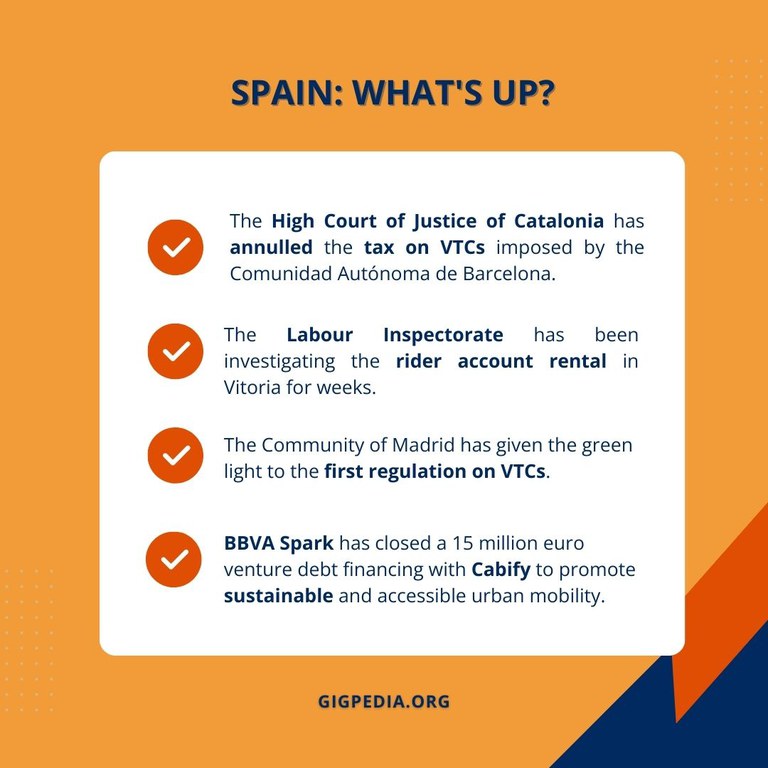
Spain - The Labour Inspectorate has announced a sanction against Delivery Hero, the German parent company of Glovo. According to the authority, 49 delivery workers in Asturias should have been employed rather than self-employed.
US - Drivers for delivery apps like DoorDash and Instacart are now entitled to minimum pay in Seattle based on a law that took effect on January 13.
Argentina - Uber drivers in Bariloche have called on the authorities to move forward in regulating how Uber operates.
Chile - To end an antitrust investigation, Uber Eats, Rappi, and Delivery Hero subsidiary PedidosYa have agreed to no longer limit restaurant partners in terms of the price they offer in other sales channels.
Sources: Elperiodico.com; Eleconomista.es; Elcorreo.com; Lavanguardia.com

India
- Preparations are underway for Swiggy's initial public offering (IPO), which is expected to raise $1 billion later this year.
- Namma Yatri, the government-backed alternative to Ola and Uber, has been launched in New Delhi. It's a direct-to-driver app that doesn't charge workers commissions.
- Zomato has announced a new feature called ‘daily payouts’ with the aim being to support its ‘emerging restaurant partners.’
Spain - Uber has reported a 38 percent increase in the demand for its business delivery service over the last two years.
UK - Just Eat Takeaway.com reported its best-ever final quarter last year in the UK and Northern Europe. Elsewhere, the business had struggled more.
US - Uber has decided to shut down its alcohol delivery service Drizly.
Vietnam - Be Group, Vietnam’s Grab rival, raised 739.5 billion dong (30 million dollars) in fresh funding.
Did you know? Data shared by Deloitte shows that 75% of the 250 Indian companies surveyed are considering gig workforce for their open positions in 2024, as against 61% last year.
Norway - Wolt and Foodora drivers face tough working conditions due to snow storms and traffic.
Turkey - Most of the couriers working at the Getir warehouse in Düzce found a recent minimum wage increase insufficient and resigned.
UK - The App Drivers and Couriers Union will hold a demonstration against West Northamptonshire Council at the end of February. Migrant workers have been asked to produce 'good conduct' certificates in order to be allowed to work.
US - Drivers led by the Minnesota Uber/Lyft Drivers Association (MULDA) Members staged a strike at Minneapolis International Airport, demanding better pay and enhanced safety measures from Uber and Lyft.
Did you know? In places like Bangladesh, Pakistan, and Vietnam, digital payments aren’t always as seamless, and drivers prioritise cash-paying passengers.
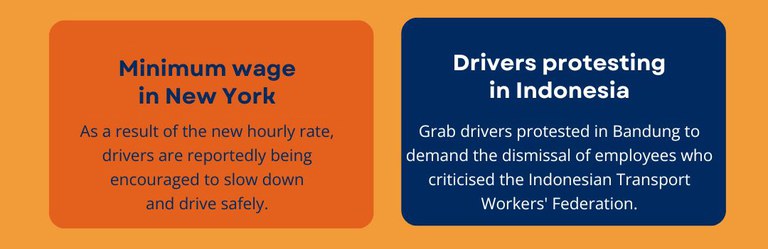
Sources: StreetsblogNYC; Prfmnews
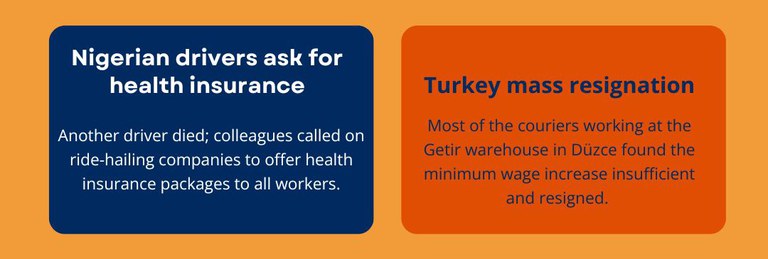
Sources: TechCabal; Kuryehaber.com